
Secret messages hidden inside equations
At the moment I am writing an introductory Mathematica course and was recently looking for inspiration for potential exercises. One website I came across (I have lost the link unfortunately) suggested that you get something interesting looking if you plot the following equation over the region -3<x<3, -5<y<5. It also suggested that you should only plot the z values in the range 0<z<0.001.

Suitably intrigued, I issued the required Mathematica commands and got the plot below which spoke to me in a way that no equation ever has before.
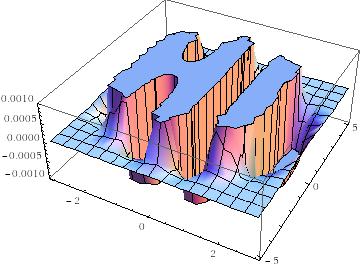
So now I have a question – What other messages could one find hidden inside equations like this? For example, is it possible to generate a three letter word with a relatively simple equation such as the one above? Of course if you were allowed to use very complex equations (and make use of Fourier transforms maybe) then I guess you could spell out whatever you choose but that’s no fun.
If anyone finds other such messages in simple(ish) equations then please let me know.
Like it! I suppose it’s a new take on “Hello World” for the advanced user!
have you plotted its derivative?
It’s like a really advanced version of writing “hello” on a digital calculator.
*goes and dusts off his TI-83*
Here’s a really weird one – I haven’t tried it myself, but it’s almost unbelievable:
http://www.kirchersociety.org/blog/2007/02/02/tuppers-self-referential-formula/
If I’m reading right, the formula actually plots itself. Hope you like.
Math is behind everything!
I love it!
are you still intrested?? let me khow i have some very very cool stuff
Yep, I’m still interested :)
EXQUISITE ! …… that f(x,y) looks more like a function straight our of ‘Potential Theory’, then again I guess it is more aesthetic ! :-)
I guess that it should be possible to do on MATLAB.
Can we make a ‘HELLO’ …. ? …. ;) (well…. this may be the start to a new encryption method – via MATLAB ….. LOL ! )
Hi,
you can check this post in xamuel.com (the blog of a friend, not mine) where he discusses parametric plots of words:
http://www.xamuel.com/graphs-of-implicit-equations/
You have to scroll down a little first.
Cheers,
Ruben
It is definitely an interesting thought towards the realm of steganography :) Not quite encryption/cryptography, but very interesting.
I am also interested in using infinite (transcendental) sequences as keys or for hiding messages if given offsets (similar to knowing the x,y,z ranges to plot).
http://www.xamuel.com/inverse-graphing-calculator.php
Handcrafted in 12 minutes:
e^(-x^2-100y^2)
+e^(-100*(x-1)^2-y^2/2)
+e^(-100*(x+1)^2-y^2/2)
+e^(-(x-5)^2-100*(y-1)^2)
+e^(-(x-5)^2-100y^2)
+e^(-(x-5)^2-100*(y+1)^2)
+e^(-100*((x-4.5)+1)^2-y^2/2)
+e^(-100*((x-8.5)+1)^2-y^2/2)
+e^(-(x-9)^2-100*(y+1)^2)
+e^(-100*((x-12.5)+1)^2-y^2/2)
+e^(-(x-13)^2-100*(y+1)^2)
+e^(-100*((x-17)+1)^2-y^2/3)
+e^(-(x-18)^2-100*(y+1)^2)
+e^(-(x-18)^2-100*(y-1)^2)
+e^(-100*((x-19)+1)^2-y^2/3)
I leave the world as an excercise
the 18s should be 17s
I thinkt this one also produces an interesting graph: (2x^2+y^2+z^2-1)^3-x^2z^3/10-y^2z^3=0
[source: http://www.mathematische-basteleien.de/heart.htm%5D
this may be salutary for students because it illustrates:
1) moving functions around
2) squeezing functions
3) adding parts by adding functions
4) (non-normalized) variants of the normal distribution
PS: the 18s should be 17s
and here is the idea behind it:
| | |– | | |–|
|-| |– | | | |
| | |– |– |– |–|
Here you can try out the 3d functions:
http://www.livephysics.com/ptools/online-3d-function-grapher.php?ymin=-3&xmin=-3&zmin=0&ymax=3&xmax=10&zmax=1&f=e^%28-x^2-100*y^2%29%2Be^%28-100*%28x-1%29^2-y^2%2F2%29%2Be^%28-100*%28x%2B1%29^2-y^2%2F2%29
Increase grid size!
For easier viewing paste each letter individually.
This site is useful as well:
http://fooplot.com/index3d.php
An inequality rather than an equation but Tupper’s self-referential formula is pretty impressive http://mathworld.wolfram.com/TuppersSelf-ReferentialFormula.html
According to the mathworld page you linked to ‘The formula itself is a general purpose method of decoding a bitmap stored in the constant k, so it could actually be used to draw any other image’.
So, the image is actually contained in the number
4858450636189713423582095962494202044581400587983244549483093085061934704708809928450644769865524364849997247024915119110411605739177407
8569197543265718554420572104457358836818298237541396343382251994521916512843483329051311931999535024137587652392648746133949068701305622
9581321948111368533953556529085002387509285689269455597428154638651073004910672305893358605254409666435126534936364395712556569593681518
4334857605266940161251266951421550539554519153785457525756590740540157929001765967965480064427829131488548259914721248506352686630476300
and not in the formula. So, it’s cool but not VERY cool IMHO :)
simplify -2i+u>-5u